Table of Contents
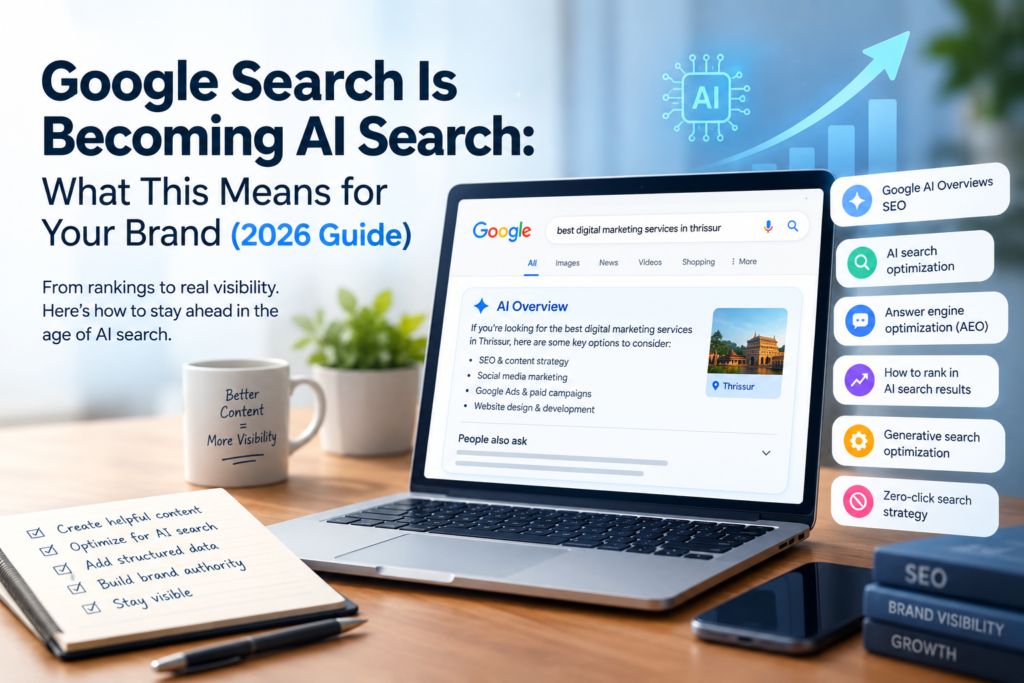
If you’ve been staring at Google Search Console wondering why your rankings look fine but your clicks keep sliding, you’re not imagining things. AI search and brand visibility are now tied together in a way traditional SEO never accounted for — and the shift is already reshaping how businesses get found online.
I noticed this firsthand when I saw organic impressions and clicks changing for informational keywords I’d been tracking for months. The rankings hadn’t moved. The content hadn’t changed. But clicks were dropping anyway. That disconnect was my first real signal that AI-generated answers — not just algorithm tweaks — were changing how users interacted with search results altogether.
The Moment It Clicked: AI Search and Brand Visibility — A Real Client Case Study
The clearest example came from a small local business website I worked with. After a Google algorithm update, their organic clicks dropped by roughly 30–40%, even though most of their keyword positions stayed relatively stable. That gap between “still ranking” and “not getting clicked” is an important part of AI search and brand visibility today. Google can answer a question directly in the search results, meaning users may never scroll down to visit the website.
Rather than panicking, I went through a full review of the site’s keyword performance, technical SEO health, and content quality. I wanted to understand whether the problem was simply rankings or whether changing search behaviour was also affecting the site’s AI search and brand visibility.
The biggest wins came from three specific changes:
- Restructuring the content to answer questions more directly and place useful answers higher up on the page
- Improving on-page SEO with clearer headings, tighter introductions, and stronger but natural keyword placement
- Adding FAQ schema to make the content easier for search engines and AI systems to understand
After implementing these changes, the site’s organic clicks gradually recovered and eventually surpassed the pre-drop numbers. That recovery was what convinced me that AI search and brand visibility isn’t something businesses should treat as a one-time SEO issue. The way people search is changing, so the way we structure and optimise content needs to change with it.
This also connects with the broader conversation around AI search and brand visibility. Analysis of AI Overview citations has found that a significant share of cited pages already have visibility in traditional Google search. That suggests traditional SEO and visibility in AI-generated search experiences are becoming increasingly connected.thriveagency
My Framework for Optimizing Content for AI Search
After running this process across multiple sites, I’ve settled into a framework I now use for every client, regardless of industry:
- Understand user intent first. Before touching a single heading, know exactly what question the page needs to answer.
- Create clear, direct content. Lead with the answer. Don’t make readers — or AI systems — dig for it.
- Optimize headings and FAQs. Structure content so key questions have their own clearly labeled sections.
- Add structured data. FAQ schema, article schema, and how-to schema all help AI systems parse and cite your content accurately.
- Improve technical SEO. Site speed, crawlability, and mobile experience still matter — arguably more, since AI systems favor sources they can access and understand quickly.
- Strengthen internal linking. Help both users and AI crawlers understand how your content connects across the site.
I also monitor performance regularly and adjust based on emerging search trends and how AI-generated results are evolving — because this isn’t a “set it and forget it” fix. It’s an ongoing process.
The Biggest Mistake I See Brands Making Right Now
Here’s the mistake that costs businesses the most ground: creating content specifically to “game” AI search instead of focusing on genuine user intent.
Keyword stuffing, repetitive AI-generated filler, and content written to hit a word count rather than answer a real question — all of it backfires. AI search systems are increasingly good at recognizing shallow, templated content and skipping over it in favor of sources that feel authentic and specific.
The fix isn’t complicated, even if it takes discipline: create original, experience-based content that directly answers customer questions. If you wouldn’t hand it to a real customer and feel confident it solves their problem, it’s not ready.
Traditional SEO vs. AI Search Optimization
| Focus Area | Traditional SEO | AI Search Optimization |
| Primary Goal | Rank #1 for keywords | Get cited/summarized accurately |
| Content Style | Keyword-optimized pages | Direct, question-answering content |
| Success Metric | Click-through rate | Visibility + brand mentions |
| Structure | Long-form, broad coverage | Scannable, FAQ-driven sections |
| Technical Priority | Speed, crawlability | Speed, crawlability, structured data |
What to Do This Week to Prepare Your Brand
You don’t need a six-month roadmap to start. Here’s a practical, same-week action plan:
- Audit your most important pages and identify where they fail to directly answer a customer question.
- List 5–10 key questions your customers actually ask — pull these from support tickets, sales calls, or Search Console queries.
- Write clear, specific answers with real examples, not generic explanations.
- Add FAQ schema to those sections so AI systems can parse and cite them easily.
- Strengthen internal links between related pages so both users and crawlers can navigate your site’s topical depth.
This mirrors exactly what worked in the case study above — small, specific changes compounding into a real recovery.
FAQs
Does AI search mean traditional SEO is dead?
No. Most AI Overview citations still come from pages that already rank well organically, so foundational SEO — technical health, relevant keywords, quality backlinks — remains the foundation AI search builds on.
How long does it take to see results after optimizing for AI search?
In the case study above, recovery was gradual rather than immediate. Expect weeks, not days, especially after algorithm-driven traffic drops.
What’s the single highest-impact change to make first?
Restructuring existing content to answer questions directly, near the top of the page, tends to produce the fastest visible improvement.
Conclusion: Adapt Now, Not Later
AI search isn’t a future trend — it’s already reshaping how clicks and visibility work today. The brands that adapt fastest aren’t the ones chasing algorithm hacks. They’re the ones creating clear, honest, question-first content that both users and AI systems can trust.
Start small: pick your five most important pages, answer the real questions your customers are asking, and build from there.
Looking for a freelance digital marketer in Thrissur to grow your business online? I provide practical digital marketing solutions tailored to your business goals, including SEO, social media marketing, content marketing, Google Ads, and website optimization. As a freelance digital marketer in Thrissur, I focus on improving online visibility, attracting the right audience, generating quality leads, and building a stronger digital presence. Whether you are a local business, startup, professional, or established company, I can help you develop an effective digital marketing strategy that supports sustainable online growth.