Table of Contents
If you’ve only ever published regular LinkedIn posts, you’re missing a format built for something posts can’t do: LinkedIn Articles give you the space to go deep. I started publishing them for exactly that reason — to share in-depth insights around digital marketing and SEO that a 200-word post simply couldn’t hold. The extra room let me explain strategies properly, walk through real examples, and build credibility in a way that quick takes never quite manage.
But space alone doesn’t make an article work. I’ve seen plenty of long-form pieces with good topics flop anyway. The difference between an article that gets read and one that gets scrolled past comes down to a few specific choices — and that’s what this guide walks through.
LinkedIn Articles vs. Posts: What’s Actually Different
The two formats aren’t interchangeable, and treating them that way is where a lot of people go wrong.
A regular post is built for one quick idea, tip, or opinion — something a reader can absorb in a few seconds while scrolling. A LinkedIn Article is different. It’s for topics that need deeper explanation: multi-step strategies, frameworks, or ideas that require examples and supporting context to actually land.
When I’m deciding which format to use, the question I ask is simple: does this topic need room to breathe? If it’s a single actionable tip, it becomes a post. If it needs structure, examples, and a walkthrough, it becomes an article.
| Factor | LinkedIn Post | LinkedIn Article |
| Length | Short (under ~300 words) | Long-form (800+ words) |
| Best For | Quick tips, opinions, updates | Strategies, frameworks, deep dives |
| Reading Time | A few seconds | A few minutes |
| Structure Needed | Minimal | Clear headings, sections, flow |
| Discovery | Feed-driven, time-sensitive | Indexable, longer shelf life |
A Real Example: What Made One Article Actually Work
One of my best-performing LinkedIn Articles covered practical SEO and digital marketing strategies specifically for small businesses. It generated strong engagement and led to several relevant connection requests — not because the topic was novel, but because of how it was handled.
Three things made it work:
- It addressed a real business challenge, not a generic industry trend
- It used simple, concrete examples instead of abstract theory
- It focused on actionable tips readers could apply immediately, rather than just explaining concepts
That last point matters most. Readers on LinkedIn are often decision-makers or professionals looking for something they can use, not just something interesting to read. An article that hands them a next step outperforms one that just informs.
My Process for Writing a LinkedIn Article
Here’s the structure I actually follow when building an article, not just a post:
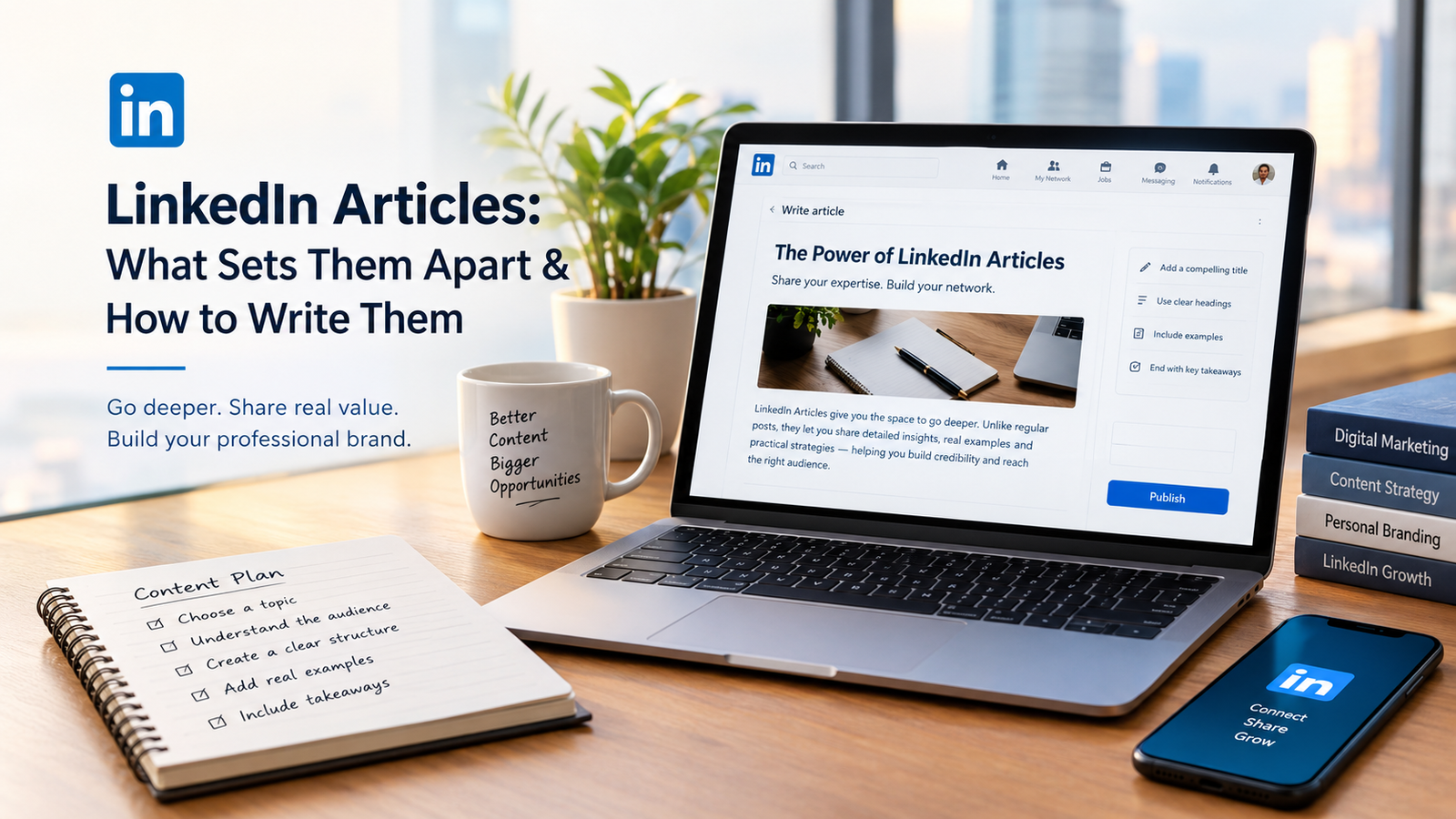
- Choose a topic that needs depth. If it can be explained in one sentence, it’s a post, not an article.
- Lead with the reader’s problem. Don’t open with your own introduction or credentials — open with what the reader is struggling with.
- Build a clear structure. Headings, short sections, and a logical flow from problem to solution.
- Add supporting examples. Theory alone doesn’t hold attention; concrete examples do.
- End with practical takeaways. Give readers something they can act on the same day.
This is the same structure behind EEAT principles that search engines (and increasingly, AI search systems) reward: real experience, clear expertise, and genuinely useful content — not filler dressed up as insight.
The Mistake That Kills Good Articles
Here’s the one I see most often: writing a long article without a clear purpose or reader-focused structure.
The topic can be great, but if the introduction is weak, the content stays generic, or there are no practical takeaways by the end, the article flops anyway. Length isn’t the goal — clarity is. A strong LinkedIn Article should be useful and easy to follow from the first line to the last, not just long enough to look substantial.
Start With This: The First-Line Rule
If you’re about to write your first LinkedIn Article, focus on this one thing: start with the reader’s problem, not your introduction.
Your first few lines should clearly state what problem you’re addressing and what the reader will learn or gain by continuing. Skip the warm-up. Skip the “I’ve been thinking about this lately” opener. Tell them immediately why this is worth their next three minutes — that’s what keeps people reading past the first paragraph.
FAQs
How long should a LinkedIn Article be?
There’s no strict rule, but articles that need real depth typically run 800 words or more. If your topic doesn’t need that space, a shorter post format usually performs better.
Do LinkedIn Articles help with visibility outside LinkedIn?
Yes — unlike regular posts, LinkedIn Articles are indexable and can surface in search results, giving them a longer shelf life than a typical feed post.
How often should I publish LinkedIn Articles?
Consistency matters more than frequency. A well-structured article once or twice a month tends to build more credibility than frequent, shallow ones.
Conclusion: Depth Only Works With Structure
LinkedIn Articles give you room that regular posts don’t — but that room is only valuable if you use it well. Lead with your reader’s problem, back your points with real examples, and close with something they can actually act on. Get that structure right, and the depth takes care of itself.
Looking for a freelance digital marketer in Thrissur to strengthen your online presence? I help businesses, startups, and personal brands build their digital visibility through practical strategies such as SEO, social media marketing, content marketing, Google Ads, and website optimization. As a freelance digital marketer in Thrissur, my focus is on attracting the right audience, improving search visibility, generating quality leads, and creating sustainable online growth. Whether you are launching a new business or looking to improve an existing digital presence, I provide customized digital marketing solutions based on your goals and target audience.