SEO Forecasting: The Ultimate Guide to Predicting Your Traffic in an AI Era
Power word: Ultimate ✅SEO Forecasting: How to Predict Your Traffic in an AI Era
If you’ve ever handed a client a single traffic number and watched actual results land nowhere near it, you already know why SEO forecasting is harder than it looks. It’s not about plugging keywords into a spreadsheet and multiplying by a fixed click-through rate. Real SEO forecasting means working with historical data, realistic assumptions, and — increasingly — accounting for how AI Overviews and AI-generated results are reshaping what a “top ranking” actually delivers in clicks.
I’ve built forecasts for local businesses and larger sites alike, and the process has changed a lot in the last couple of years. Here’s what actually works now.
What Is SEO Forecasting?
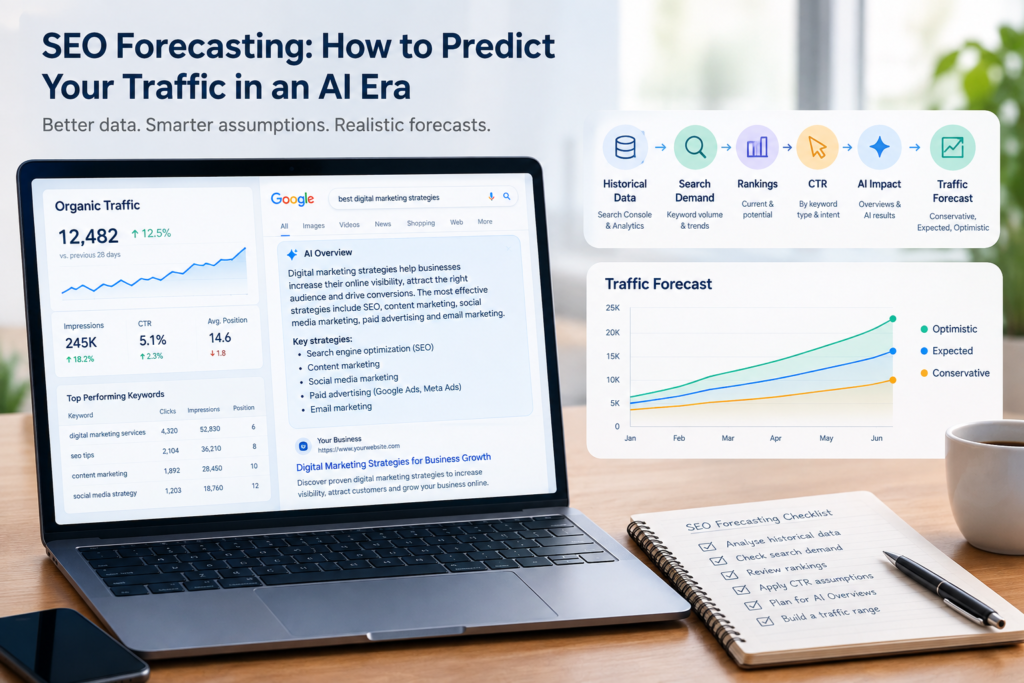
SEO forecasting is the process of predicting future organic traffic based on historical performance, current rankings, search demand, and planned SEO improvements. Done well, it gives clients or stakeholders a realistic sense of what to expect from SEO investment — not a guarantee, but a data-informed estimate.
The starting point is almost always the same: historical organic traffic and Google Search Console data. That means looking at current clicks, impressions, rankings, and top-performing keywords and pages, and tracking how those numbers have shifted over time. From there, you layer in the site’s existing content, search demand, competitive landscape, and any planned improvements before estimating what traffic could look like months down the line.
Why Forecasting Has Gotten Harder in the AI Era
Traditional SEO forecasting relied on a fairly stable assumption: better rankings lead to more clicks, roughly in line with known click-through-rate curves by position. That assumption is breaking down.
With AI Overviews and other AI-generated results taking up more space at the top of search results, ranking improvements don’t always translate directly into more clicks. A page can move from position 8 to position 3 and still see a smaller traffic bump than expected, simply because an AI-generated summary is now answering the query before anyone scrolls to organic results.
This means forecasting today has to account for more than position. It needs to factor in:
- Impressions – is the page even being shown for relevant queries?
- Click-through rate by keyword type – informational queries are far more likely to be absorbed by AI Overviews than transactional ones
- Search intent – navigational and transactional intent tend to hold up better for organic clicks than broad informational intent
- The type of keywords being targeted – not all rankings carry equal click value anymore
A Practical SEO Forecasting Process
Here’s a straightforward process that works without needing expensive tools or overly complex modeling:
- Pull historical Search Console data – clicks, impressions, rankings, and trends over the past 6–12 months.
- Estimate search volume for target keywords using available tools.
- Assess current rankings and realistic ranking improvement potential based on content quality and competition.
- Apply a realistic CTR assumption per keyword and position — not one fixed CTR across every query. A branded transactional term and a broad informational term at the same position will not convert to clicks at the same rate, especially with AI Overviews in play.
- Build three scenarios: conservative, expected, and optimistic. This gives stakeholders a range instead of one number that looks more certain than it actually is.
That three-scenario structure matters more than most people realize. A single forecasted number implies a precision that SEO simply doesn’t offer. A range communicates honesty — and it protects you when results land somewhere between “good” and “great” instead of exactly on target.
A Real Example: When the Forecast Matched Reality
On one project — a local business website — the forecast called for gradual organic traffic growth following content improvements and more targeted local keyword optimization. The actual traffic followed that forecast fairly closely over the following months.
What made that forecast accurate wasn’t a fancy model. It was built on existing Search Console data, realistic keyword opportunities, and conservative assumptions, rather than assuming every targeted keyword would rank quickly. That’s really the core lesson: forecasts hold up when they’re grounded in what the data already shows, not in best-case hope.
Common Mistakes in SEO Forecasting
The most common mistake is assuming that a ranking improvement produces a proportional traffic increase — for example, expecting that moving from position 10 to position 3 will automatically triple clicks. In practice, search volume, CTR, competition, seasonality, and AI-generated results can all affect how many of those clicks actually materialize.
A few other patterns worth avoiding:
- Using one fixed CTR curve for every keyword regardless of intent or competitiveness
- Presenting a single traffic number instead of a range
- Ignoring how much of a keyword’s search space AI Overviews are already occupying
- Treating forecasts as guarantees rather than estimates based on available data
Rankings vs. Visibility vs. Traffic: Why the Distinction Matters
| Metric | What It Measures | Why It’s Not the Whole Picture |
| Rankings | Position for a given keyword | Doesn’t account for AI Overviews absorbing clicks |
| Impressions | How often your page appears | Shows visibility, not engagement |
| Click-through rate | % of impressions that convert to clicks | Varies heavily by intent and AI presence |
| Organic traffic | Actual clicks to your site | The real outcome — but shaped by all of the above |
The goal isn’t just higher rankings anymore — it’s visibility, qualified traffic, and conversions. That reframing is worth explaining clearly to clients or stakeholders before you hand over any forecast.
FAQs
How accurate can an SEO forecast really be?
It’s an estimate, not a guarantee. Accuracy improves when it’s based on solid historical data, realistic keyword-specific CTR assumptions, and conservative scenario planning — but external factors like AI Overviews, seasonality, and algorithm changes can still shift results.
Do AI Overviews always reduce organic clicks?
Not always — it depends on search intent. Informational queries tend to be more affected than transactional or navigational ones, since AI-generated summaries often satisfy the query directly.
What tools do I need to forecast SEO traffic?
At minimum, Google Search Console for historical performance data and a keyword research tool for search volume estimates. Sophisticated forecasting software can help, but isn’t required to build a reasonably accurate estimate.
Should I give clients one traffic number or a range?
A range. Presenting conservative, expected, and optimistic scenarios sets realistic expectations and avoids overpromising on a single figure.
Conclusion: Forecast with Ranges, Not Promises
SEO forecasting in the AI era means working with more variables than before — impressions, intent, and AI Overview presence now matter as much as raw rankings. The most reliable approach is still the simplest one: start with real Search Console data, apply keyword-specific CTR assumptions, and present a conservative-to-optimistic range instead of a single number. Treat every forecast as a realistic estimate, not a guarantee, and you’ll build the kind of trust that keeps clients around long after the first report.
If you’re looking for a freelance digital marketing professional in Thrissur, I provide practical digital marketing solutions designed to help businesses improve their online presence, attract the right audience, and generate more enquiries. My services include SEO, social media marketing, Google Ads, content marketing, local SEO, and overall digital marketing strategy. As a freelance digital marketer in Thrissur, I focus on understanding each business, creating a suitable marketing plan, and using data-driven strategies to achieve sustainable online growth.